The first sign that your business has outgrown its power system may not be a blackout.
It could be the new machine that keeps struggling to run. The generator that now works for hours longer than it used to. The rising energy bill. Or the simple fact that your team has started planning work around when power is available.
That is the interesting thing about business growth: the problems do not always arrive with a warning.
A business can grow in revenue, customers and staff while some of the systems behind it remain exactly where they were years ago.
And eventually, something has to give.
The systems that helped you grow may eventually become the systems that slow you down.
Energy is one of those systems.
As a business expands, its business energy needs can change significantly. More equipment means more electricity. Longer working hours mean more hours of energy consumption. New branches and facilities bring additional power requirements.
Growth changes the business.
It should also change the way the business thinks about energy.
Growth Changes More Than Your Revenue
When business owners think about growth, they naturally think about sales.
More customers.
More orders.
More staff.
More products.
More branches.
But growth also creates pressure behind the scenes.
A business with more employees needs more workstations. More equipment means more electricity. Longer operating hours mean more energy consumption. New facilities create additional power requirements.
What worked before may suddenly feel stretched.
Consider a business that started with a small office and a few computers. Over time, it adds air conditioners, more staff, refrigeration, networking equipment, production machinery and longer working hours.
The business has not simply become bigger.
Its energy profile has changed.
Yet many businesses continue using the same approach to power because it has always been there.
That is where yesterday’s solution can become tomorrow’s limitation.
When “Good Enough” Stops Being Good Enough
There is nothing wrong with a solution that works.
The problem begins when “it works” becomes the only standard used to make business decisions.
A generator can keep operations running.
The grid can supply power when available.
An existing inverter can support some loads.
But the real question is whether the entire energy setup still makes sense for the business today.
A business may be operating successfully while spending more than necessary to keep its operations powered.
It may be using a generator more frequently because demand has increased. It may be running equipment at times when energy availability is less favourable. It may have no clear strategy for what happens when grid power goes off.
These issues can easily become accepted as part of doing business.
But sometimes what looks like a normal operating cost is actually a sign that the business has outgrown its approach.
You can keep turning up the volume, but at some point you have to upgrade the speaker.
The same principle applies to energy.
Energy Is Part of the Business, Not Just the Building
Energy is often treated as a facilities issue.
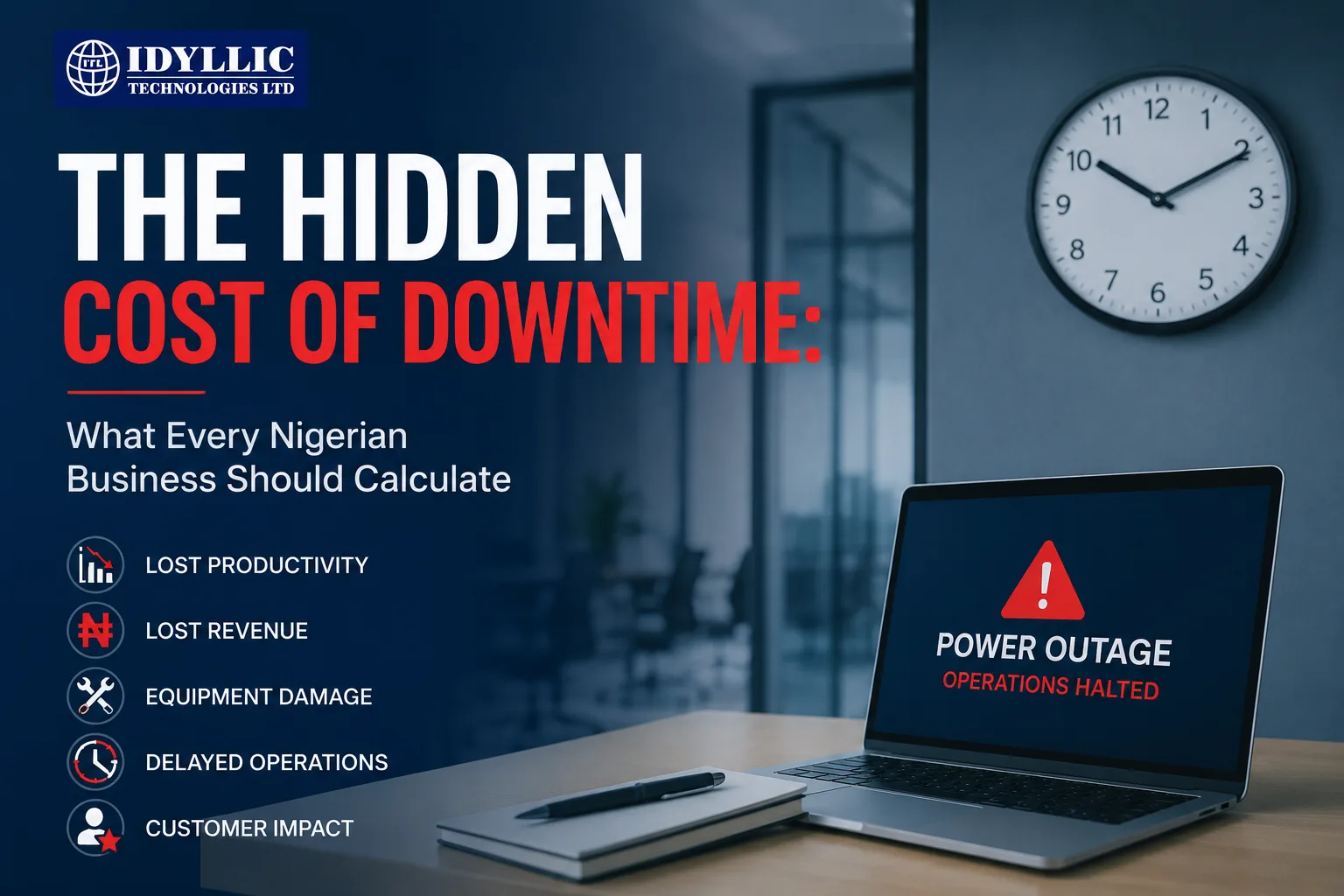
But think about what happens when power becomes unreliable.
A production line can stop.
A cold room can be affected.
Employees can lose productive hours.
Customers may have to wait.
Equipment can be interrupted.
A business may spend more on fuel just to keep normal operations going.
None of these problems exist in isolation.
They can affect the wider business.
This is why energy should be viewed as part of the operating strategy rather than simply something that happens in the background.
The question should not only be:
“How much electricity do we use?”
It should also be:
“What does our business need its energy system to help us achieve?”
That is a very different question.
Your Energy System Should Follow Your Business
There is no single power setup that is right for every business.
A retail store does not operate like a manufacturing facility.
A hotel does not have the same energy pattern as an office.
A cold-storage business has different priorities from a professional services company.
Even two businesses in the same industry can have very different energy needs.
This is why choosing a solar system, inverter or battery simply because another business uses it can be a mistake.
The solution should start with the business.
What equipment needs to run?
Which loads are essential?
When does the business use the most energy?
How many hours does it operate?
What happens when grid power is unavailable?
What is the existing backup arrangement?
What changes are expected in the next two or three years?
These questions help move the conversation from buying equipment to designing an energy strategy.
Where Does Solar Fit In?
This is where solar energy for businesses can become an important part of the conversation.
For businesses with suitable operating patterns and energy needs, solar can help provide electricity during daylight hours and reduce reliance on other sources of power.
When combined with battery storage, excess energy can also be stored for later use, depending on the system design.
An inverter manages the conversion and flow of energy between the different parts of the system.
But the technology itself is only one part of the decision.
The bigger question is how the technology fits the business.
Solar should not be installed simply because it is popular or because another company has installed it.
The right energy solution is not the one with the biggest number on the brochure. It is the one that makes sense for the way your business actually operates.
That could mean solar.
It could mean solar combined with battery storage.
It could mean integrating solar with the existing grid and backup systems.
The right answer depends on the business.
Bigger Is Not Always Better
There is a common assumption that a bigger power system must be a better power system.
It sounds logical.
If 10kW is useful, perhaps 20kW must be better.
But business decisions rarely work that simply.
Installing more capacity than the business needs can mean paying for resources that are not being fully used. Installing too little can create another problem by leaving important loads unsupported.
The objective should be fit, not size.
Think of it like buying a vehicle for a business.
A delivery company has different needs from a consulting firm. Buying the largest vehicle available does not automatically make it the right vehicle.
The same applies to an energy system.
The right solution should match the business’s current requirements while leaving room for sensible future growth.
What Happens When Businesses Plan Energy Too Late?
Sometimes, businesses only review their power systems after something goes wrong.
A new machine is purchased and the existing system struggles with the load.
A new branch opens and the business discovers that its energy plan does not scale easily.
Generator costs increase and suddenly energy becomes a much larger expense.
An outage interrupts an important operation.
At that point, the business is no longer planning.
It is reacting.
And reactive decisions can be more expensive because they are made under pressure.
A better approach is to review the energy system before the business reaches that point.
When a business is planning expansion, purchasing major equipment or increasing operating hours, energy should be part of the conversation from the beginning.
The Questions Worth Asking Before Your Next Expansion
Before adding new equipment, opening another location or significantly increasing operations, take a fresh look at your energy situation.
Ask:
What has changed?
Compare your current operation with where you were two or three years ago.
What consumes the most energy?
Identify the equipment and processes that place the greatest demand on your system.
What cannot afford to stop?
Not every load has the same level of importance. Knowing your critical loads helps you make better decisions about backup and energy storage.
How much are you spending to keep operations running?
Look beyond the electricity bill. Consider generator fuel, maintenance, servicing and the operational cost of interruptions.
What is likely to change next?
If you plan to add machinery, staff, working hours or locations, your future energy requirements should form part of today’s planning.
Could solar play a role?
If your business has significant daytime energy demand, solar may be worth evaluating as part of a wider energy strategy.
The important word is evaluating.
The goal is not to force solar into the conversation.
The goal is to understand whether it makes business sense.
Stop Treating Energy as an Afterthought
A business spends time planning its finances.
It plans its marketing.
It plans its staffing.
It plans its expansion.
Energy deserves the same attention.
Because when the systems supporting the business are not keeping pace, growth can expose the weakness.
The answer is not always to replace everything.
Sometimes the existing system can be upgraded. Sometimes additional battery storage makes sense. Sometimes solar can reduce dependence on other power sources. Sometimes a completely different energy strategy is required.
The important thing is to make the decision based on the business rather than simply reacting to the next power problem.
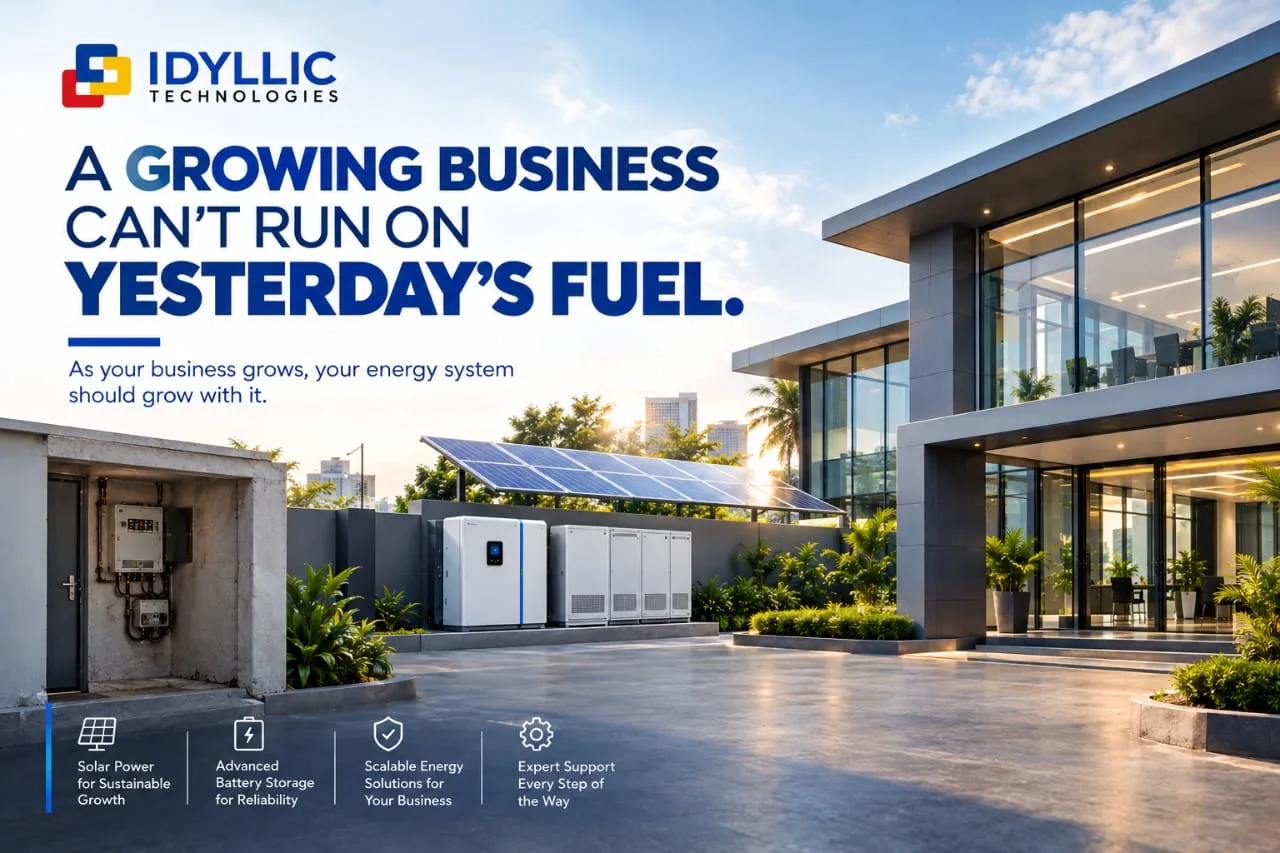
Yesterday’s solution was designed for yesterday’s business.
Your business today may need something different.
Build the Energy Strategy Around the Business You Are Becoming
Business growth is exciting because it means something is working.
But growth also changes the demands placed on the systems behind the business.
Your energy needs can change.
Your operating hours can change.
Your equipment can change.
Your priorities can change.
Your energy strategy should be able to change with them.
Solar power, battery storage and modern inverter technology give businesses more options than simply relying on one source of power. But technology creates the most value when it is properly matched to the business.
At Idyllic Technologies, we look beyond individual products to understand the energy requirements behind your operation and help identify solutions that fit your business today while considering where it is going next.
Because a growing business should not have to keep running on yesterday’s fuel.
Is your current energy setup supporting your growth—or quietly holding it back?
Talk to Idyllic Technologies about assessing your business energy needs and exploring a solution built around the way you operate.