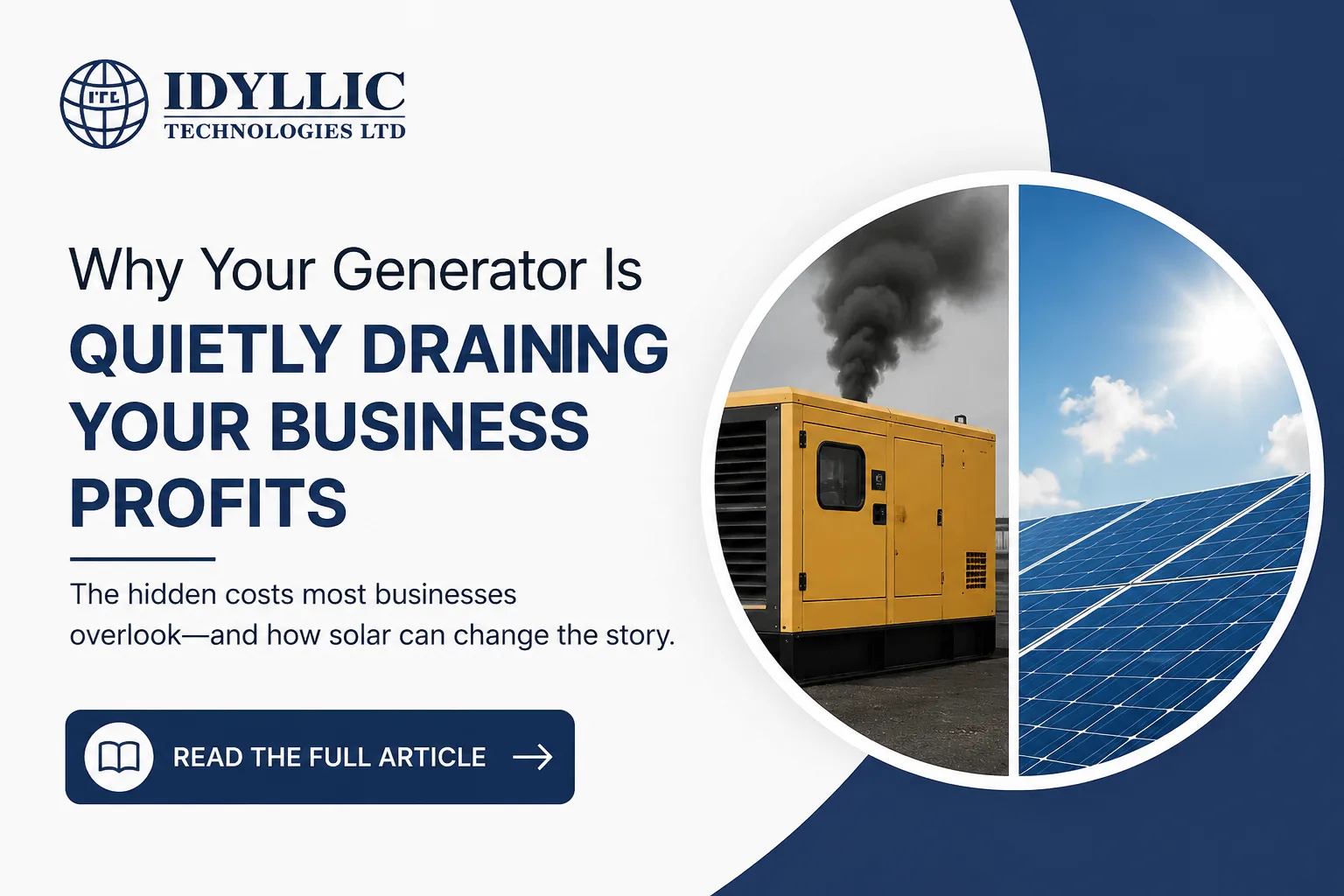
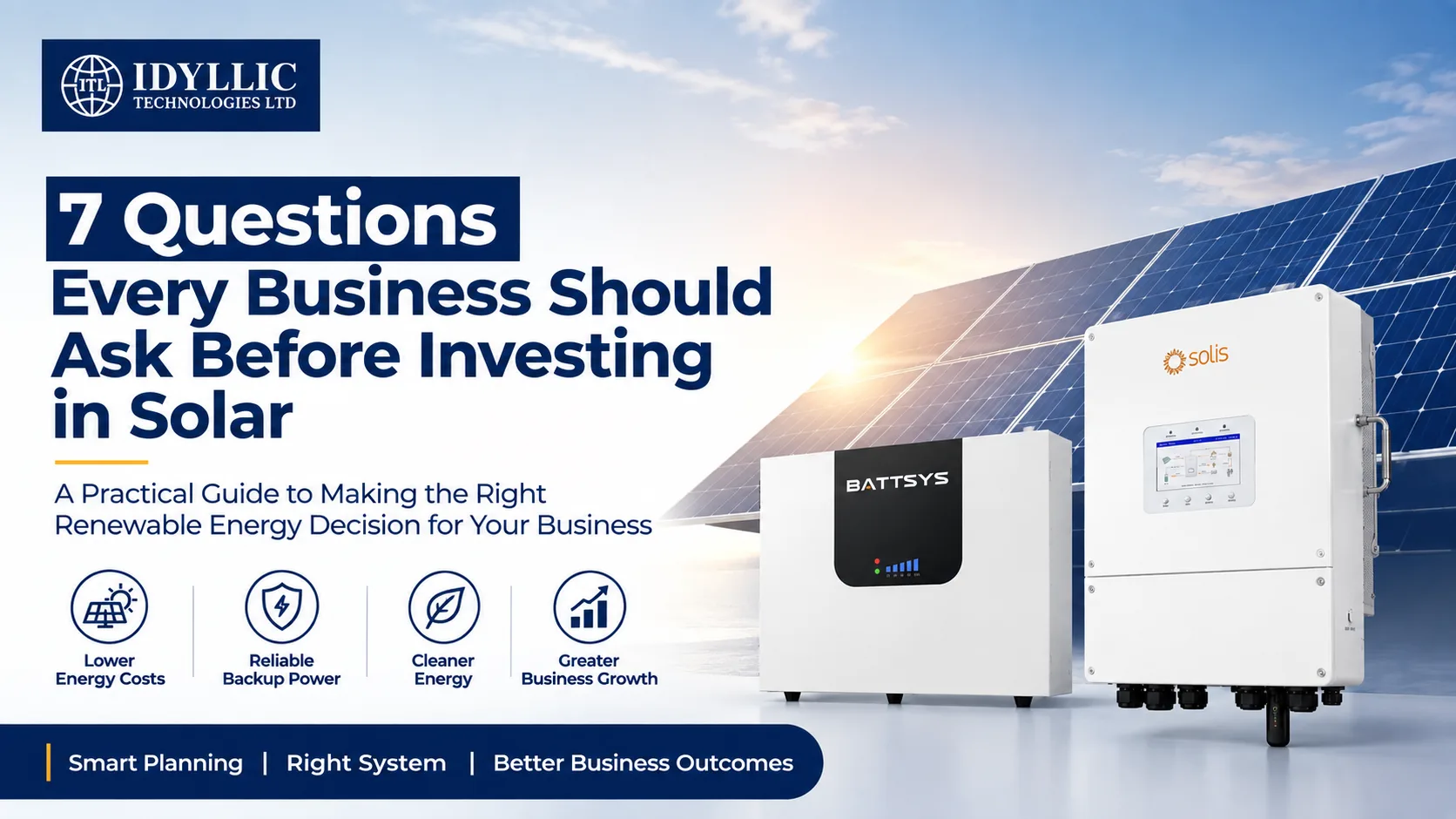
For many businesses in Nigeria, electricity is more than a utility expense.
It is part of the cost of doing business.
When power interruptions affect your computers, refrigeration, production equipment, internet connection, security systems, air conditioning or other essential operations, the cost can quickly go beyond the price of fuel or electricity.
This is why more businesses are exploring solar energy, battery storage and other renewable energy solutions as part of their long-term power strategy.
But investing in solar is not as simple as buying an inverter and installing some solar panels.
A properly designed commercial solar system should be based on how your business actually consumes electricity, the equipment you need to operate, how much backup power you require and what you want your energy system to achieve over the next several years.
Before investing in solar for your business, ask these seven questions.
1. How Much Electricity Does My Business Actually Use?
This should be your starting point.
Before talking about inverter sizes, solar panels or batteries, you need to understand your energy consumption.
Two businesses operating in similar-sized buildings can have completely different electricity requirements.
For example, an office may primarily use:
Computers
Air conditioners
Lighting
Printers
Internet equipment
CCTV
Refrigerators
Office appliances
A restaurant may have additional high-energy loads such as:
Freezers
Commercial refrigerators
Water pumps
Kitchen equipment
Extractor fans
Air conditioners
Ice makers
A manufacturing or processing business may have an entirely different energy profile because of motors, compressors, machinery and production equipment.
Start by identifying your loads
Create a list of the equipment your business uses and determine:
What equipment do you operate?
What is the rated power of each appliance or machine?
How many hours does it operate daily?
Which loads operate simultaneously?
Which equipment must remain powered during an outage?
Which loads can be switched off or scheduled?
This gives you a much clearer picture of your business’s peak power demand and daily energy consumption.
And this leads to an important distinction:
kW vs kWh
kW (kilowatts) tells you how much power your equipment needs at a particular moment.
kWh (kilowatt-hours) tells you how much energy you consume over a period of time.
Understanding both is essential when designing a commercial solar power system.
2. What Do I Actually Want Solar to Do for My Business?
Not every business needs solar for the same reason.
For some businesses, the priority is reducing dependence on the grid.
For others, it is reducing generator runtime and fuel costs.
Another business may primarily want reliable backup power for critical equipment.
And some businesses want to combine all three.
Before investing in a solar energy system, define your primary objective.
Are you looking to:
Reduce generator usage?
A solar and battery system can reduce the number of hours your generator needs to operate, depending on your load profile and system configuration.
Reduce dependence on the grid?
Solar energy can provide an additional source of electricity and, with battery storage, can continue supporting selected loads when grid power is unavailable.
Protect critical business operations?
A properly designed backup power system can prioritise essential loads such as computers, internet equipment, refrigeration, security systems and other critical equipment.
Reduce long-term energy costs?
Solar can reduce the amount of electricity your business needs to obtain from other sources. The financial outcome depends on your consumption, system cost, operating profile, financing and other factors.
Build a more resilient energy system?
This is increasingly important for businesses that cannot afford prolonged power interruptions.
The goal should therefore not simply be:
“I want solar.”
It should be:
“I want an energy system that solves this specific business problem.”
3. What Size Solar System Do I Need?
This is one of the most common questions businesses ask—and one of the easiest to get wrong.
You may have seen systems advertised as:
5kW
10kW
15kW
20kW
30kW
50kW
100kW and above
But choosing the largest system you can afford is not necessarily the right approach.
Likewise, choosing the cheapest system may leave your business with insufficient capacity.
The correct system size should be based on your actual electrical load and energy requirements.
For example, a business with a maximum demand of 12kW may not necessarily need a 20kW system for every application.
On the other hand, if your business regularly operates loads approaching or exceeding 20kW, a smaller inverter may not be appropriate.
Your system design may include:
Solar panels — generate electricity from sunlight.
Solar inverter — converts and manages electrical energy for your loads and system.
Battery storage — stores energy for use when solar production is low or when grid power is unavailable.
Changeover/control equipment — manages the interaction between available power sources depending on the system architecture.
Generator integration — where required, the solar system can be designed alongside an existing generator.
This is why commercial solar should be designed around your loads rather than selected from a catalogue based only on inverter capacity.
4. How Much Battery Storage Do I Need?
A solar inverter and a battery do two different jobs.
Your inverter determines how much power the system can deliver at a given time, while battery capacity determines how much stored energy is available.
For example, suppose your business has an average critical load of 10kW and you want approximately 4 hours of backup.
A simple energy calculation would be:
10kW × 4 hours = 40kWh
That gives you an initial indication of the amount of usable energy required.
However, real-world battery sizing also needs to consider:
Battery chemistry
Usable battery capacity
Depth of discharge
System losses
Battery operating limits
Expected future loads
Solar charging during the day
Desired reserve capacity
Generator or grid availability
This is why simply saying “I need a 20kW inverter” does not tell you how much battery storage you need.
A business requiring only short-duration backup may need a very different battery configuration from a business that wants several hours of overnight backup.
5. What Loads Should My Solar System Power?
This is where businesses can make their solar investment significantly more efficient.
You don’t necessarily need to power everything during an outage.
Instead, divide your loads into categories.
Critical Loads
These are the systems your business needs to keep running.
For example:
Computers
Servers
Internet equipment
CCTV
Security systems
Refrigeration
Essential lighting
Medical equipment where applicable
Important Loads
These improve operations but may not need to run continuously.
Examples include:
Air conditioning
Water pumps
Additional lighting
Office appliances
TVs and displays
Heavy Loads
These can consume substantial amounts of electricity.
Examples include:
Industrial machinery
Large compressors
Welding equipment
Large pumps
Commercial heating equipment
Heavy kitchen equipment
Separating your loads this way can help your solar installer or renewable energy provider design a more practical system.
Instead of paying to back up every appliance, you can prioritise the equipment that protects your revenue and business continuity.
6. Will Solar Really Save My Business Money?
This is the question every serious business owner should ask.
Solar is an investment, so the decision should go beyond:
“How much does a solar system cost?”
You should also consider:
“What is my current cost of unreliable power?”
Calculate your existing energy expenses, including:
Generator fuel
Generator maintenance
Grid electricity
Generator servicing
Downtime
Spoiled products
Equipment interruptions
Lost productivity
Business disruptions
For example, a business that relies heavily on a diesel or petrol generator may spend a significant amount on fuel over several years.
A solar-plus-battery system can potentially reduce generator runtime and fuel consumption, depending on how the system is designed and operated.
However, a professional assessment should look at the complete economics.
Important financial considerations include:
Initial system cost
How much will the solar panels, inverter, batteries, installation and associated equipment cost?
Operating and maintenance costs
What will the system require over its lifetime?
Energy savings
How much electricity or generator fuel could the system realistically offset?
Battery replacement
Battery lifespan depends on the battery technology, usage, operating conditions and other factors.
System lifespan
Solar panels, inverters and batteries have different expected service lives and warranty terms.
Return on investment
How long could it take for the energy savings to recover the initial investment?
A good solar provider should help you understand these factors rather than simply quoting a system price.
7. Who Will Design, Supply and Install the System?
This question is often overlooked.
A solar system is only as good as its design, installation, components and ongoing support.
You should therefore evaluate the company behind the system—not just the products.
Before choosing a solar energy company in Nigeria, ask:
Do they understand commercial solar systems?
Can they assess your electrical loads?
Do they supply genuine equipment?
What inverter brands do they work with?
What battery technologies do they offer?
Can they design hybrid solar systems?
Can they integrate solar with existing generators?
Do they provide installation and commissioning?
What warranties are available?
Is after-sales support available?
Can they support future system expansion?
This becomes particularly important when your solar system is powering a business.
A residential installation and a commercial energy system may have very different design requirements.
Your provider should understand not only solar technology but also business continuity, energy management and backup power requirements.
Solar Is More Than Solar Panels
One of the biggest misconceptions about renewable energy is that a solar system is simply a collection of panels on a roof.
A modern business energy system can combine several technologies.
Solar PV
Solar photovoltaic panels generate electricity from sunlight.
Hybrid Solar Inverters
A hybrid inverter can manage energy from sources such as solar, batteries and the grid, depending on the system architecture and inverter capabilities.
Battery Energy Storage
Battery systems store electrical energy for later use, helping businesses manage periods when solar generation is unavailable or insufficient.
Lithium Batteries
Lithium battery technology is increasingly used in modern energy storage systems because of its energy density, efficiency and suitability for repeated cycling, although the right battery depends on the application and system design.
Generator Integration
For businesses that already depend on generators, solar does not necessarily have to mean abandoning the generator.
Instead, the system can be designed as part of a broader hybrid power solution.
The result can be a more flexible combination of:
Solar + Battery + Grid + Generator
rather than relying entirely on a single source of electricity.
Why Commercial Solar Makes Sense for Growing Businesses
As a business grows, its energy requirements often grow with it.
You may add:
More employees
More computers
More air conditioners
Additional refrigeration
New machinery
More office space
Additional branches
Extended operating hours
This means your energy strategy should also account for future demand.
A system that meets today’s requirements but cannot accommodate tomorrow’s growth may become restrictive.
That is why we recommend considering future expansion when designing a commercial solar system.
Your energy solution should support your business—not become another limitation.
Why Choose Idyllic Technologies for Your Business Energy Needs?
At Idyllic Technologies, we believe choosing a renewable energy solution should begin with understanding the customer’s energy requirements.
We provide renewable energy and backup power solutions for homes, businesses and commercial applications, helping customers select the right combination of solar, inverter and battery technologies for their needs.
Our approach is centred around the actual application.
That means looking at:
Your current electricity consumption
Your peak loads
Your critical equipment
Your backup requirements
Your solar potential
Your battery requirements
Your existing generator
Your future energy needs
From there, the right equipment and system configuration can be considered.
Whether you need a solar inverter, lithium battery, hybrid solar system, commercial solar installation or complete backup power solution, the objective should always be the same:
Build an energy system that works for your business.
The Bottom Line
Investing in solar is a major decision for any business.
The right system can do more than generate electricity. It can help improve energy reliability, reduce generator dependence, protect critical operations and support long-term business continuity.
But the right system for one business may be completely wrong for another.
Before investing, ask yourself these seven questions:
How much electricity does my business actually use?
What do I want solar to achieve?
What size solar system do I really need?
How much battery storage do I require?
Which loads are critical to my business?
Will the investment make financial sense?
Who will design, supply and support my system?
Once you have answers to these questions, choosing the right solar power system, inverter, battery and backup solution becomes much easier.
And if you’re considering solar for your business in Nigeria, don’t start with the question:
“Which solar system should I buy?”
Start with:
“What does my business need from its energy system?”
That’s where the right solution begins.
Idyllic Technologies
Renewable Energy & Backup Power Solutions
From solar power systems and hybrid inverters to lithium battery storage and commercial backup solutions, Idyllic Technologies helps businesses build more reliable and efficient energy systems.