Solar energy is becoming an increasingly important part of how businesses in Nigeria manage unreliable grid power, rising energy costs, and the need for business continuity.
But before investing in solar panels, an inverter, or battery storage, there is one important step that should come first:
A proper power assessment.
Many businesses start their solar journey by asking, “How many kilowatts of solar do I need?”
While that is an important question, it should not be the first one.
The better question is:
“What does my business actually need its power system to do?”
A professional power assessment helps answer that question. It provides a clear understanding of how your business uses electricity and creates the foundation for designing a solar and backup power solution that matches your actual requirements.
At Idyllic Technologies Limited, we believe reliable energy starts with understanding the business first and selecting equipment second.
What Is a Power Assessment?
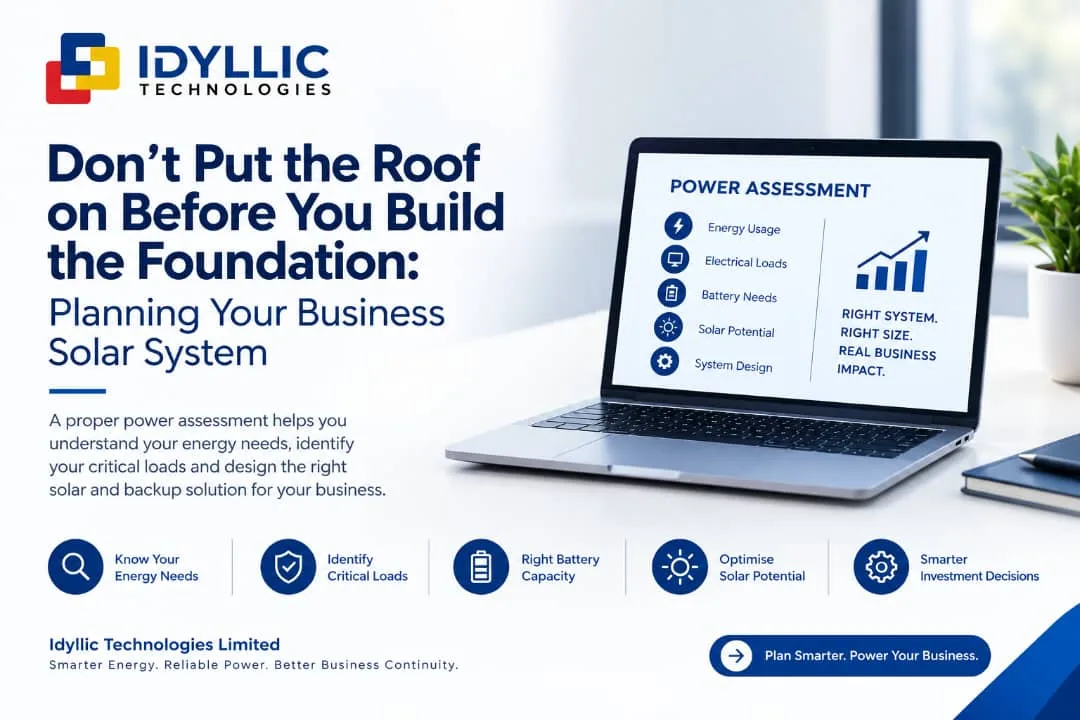
A power assessment is a detailed evaluation of a business’s electricity requirements.
It looks beyond the total number of appliances or electrical equipment in a building. A proper assessment considers how those loads operate, when they are used, which ones are critical, and how much backup power the business actually needs.
Depending on the business, an assessment may consider:
Current electricity consumption
Electrical loads and equipment
Operating hours
Peak power demand
Essential and non-essential loads
Existing power sources
Solar energy potential
Inverter capacity requirements
Battery storage requirements
Backup duration
Future energy needs
The objective is simple:
Design the power system around the business — not the other way around.
Why Should a Business Have a Power Assessment Before Solar?
1. It Helps Determine the Right Solar System Size
Solar systems are not designed based simply on the size of a building or the number of appliances inside it.
A business may have a large number of electrical devices but only need some of them running during a power outage. Another business may have fewer devices but require high-power equipment to operate continuously.
A power assessment helps determine the appropriate system capacity based on actual energy requirements.
This can help prevent the business from investing in a system that is too small for its needs.
2. It Identifies Your Critical Loads
Not every electrical load has the same level of importance.
For a business, critical loads might include:
Computers and servers
Internet and networking equipment
Security systems
Refrigeration equipment
Point-of-sale systems
Lighting
Medical or specialised equipment
Production equipment
Communication systems
A professional assessment helps identify which equipment should remain operational when grid power is unavailable.
This is especially important when designing a backup power solution.
Instead of trying to power everything unnecessarily, the system can be designed to prioritise the loads that matter most to business operations.
3. It Helps Determine Battery Requirements
Solar panels generate electricity during the day, but businesses may also need power in the evening, during outages, or when solar production is low.
That is where battery storage becomes important.
The right battery capacity depends on factors such as:
The loads that need backup
How long backup power is required
Daily energy consumption
Solar generation
Charging opportunities
Business operating patterns
Without understanding these factors, it can be difficult to determine the appropriate battery storage capacity.
A power assessment provides the information needed to make that decision more accurately.
4. It Helps Businesses Understand Their Energy Consumption
One of the biggest advantages of a power assessment is visibility.
Many businesses know that they spend a significant amount on electricity, but they may not fully understand where their energy is going.
An assessment can help identify major energy-consuming equipment, usage patterns and areas where energy management may be improved.
This creates a stronger foundation for developing a long-term renewable energy strategy.
Solar Is Not a One-Size-Fits-All Solution
There is no single solar system that is right for every business.
A small office, hotel, retail store, hospital, restaurant, school, manufacturing facility and large commercial operation can have completely different energy requirements.
For example, two businesses may have similar buildings but very different electrical loads.
One may mainly require power for computers, lighting and networking equipment.
The other may depend on refrigeration, pumps, air-conditioning systems or production machinery.
Giving both businesses the same solar system simply because their buildings are similar would not necessarily produce the right result.
This is why professional commercial solar assessment and system design matter.
What Happens During a Professional Power Assessment?
A professional power assessment typically involves several important steps.
Step 1: Understanding Your Business
The first step is understanding how your business operates.
This includes looking at operating hours, critical activities, existing power sources and what happens when grid power fails.
Step 2: Assessing Electrical Loads
The electrical equipment used by the business is assessed to understand its power requirements.
This helps determine the expected load and identify which equipment should be prioritised during backup operation.
Step 3: Analysing Energy Usage
Energy consumption patterns are reviewed to understand how much electricity the business uses and when it uses it.
This information helps inform the solar generation and battery storage requirements.
Step 4: Defining Backup Priorities
Not every load necessarily needs to operate during an outage.
The assessment helps separate essential loads from loads that can be switched off or managed differently during backup operation.
Step 5: Developing the Energy Strategy
Once the business’s requirements are understood, the information can be used to develop an appropriate energy solution.
Depending on the requirements, this could include solar panels, a solar inverter, battery storage, grid integration and other backup power technologies.
The goal is not simply to install equipment.
The goal is to create an energy system that works for the business.
What Can Happen If You Skip the Power Assessment?
Choosing equipment before understanding your energy requirements can create several problems.
An Undersized System
A system that cannot adequately support the required loads can lead to disappointing performance and continued dependence on other power sources.
An Oversized System
Going significantly beyond what the business actually needs can result in unnecessary upfront costs.
Insufficient Battery Capacity
If battery requirements are not properly calculated, the available backup duration may not meet the business’s expectations.
Poor Load Prioritisation
Without identifying critical loads, a business may use valuable stored energy on non-essential equipment while important operations are left without adequate backup.
Unclear Expectations
A properly designed system should have clearly defined expectations around what it can power, for how long, and under what conditions.
This is why the problem is not always the quality of the solar panels, inverter or battery.
Sometimes, the real problem is that the system was not properly matched to the business in the first place.
A Power Assessment Can Help You Make Better Investment Decisions
Investing in solar is a significant decision for any business.
Rather than starting with:
“Which inverter should we buy?”
A better starting point is:
“What energy solution does our business actually need?”
Once that question is answered, decisions about solar panels, inverter capacity, battery storage and other components become much more informed.
This approach can help businesses avoid unnecessary expenditure while building an energy system that is better aligned with their operational needs.
Why Professional Solar System Design Matters
A solar energy system is more than a collection of products.
The inverter, solar panels, batteries and electrical loads must work together as part of a properly designed system.
Professional system design considers factors such as:
Load requirements
Energy consumption
Solar generation
Inverter capacity
Battery storage
Backup requirements
Operating patterns
Future expansion
At Idyllic Technologies Limited, we approach energy solutions from this systems perspective.
Our goal is to help businesses move beyond simply buying equipment and toward developing a reliable energy strategy designed around their actual needs.
Is Solar Right for Your Business?
Solar can be a valuable solution for businesses looking to reduce dependence on unreliable grid power and strengthen their energy resilience.
However, the right solution depends on the business.
The most effective approach is to understand your energy requirements first and then design the system around them.
Whether your business needs a small backup solution or a more comprehensive commercial solar and battery system, a professional assessment provides the information needed to make better decisions.
Frequently Asked Questions
Do I need a power assessment before installing solar?
A power assessment is highly recommended because it helps determine your actual energy and backup requirements before equipment is selected.
How is a solar system size determined?
Solar system sizing depends on factors such as energy consumption, electrical loads, operating patterns, available solar resources, backup requirements and future energy needs.
Does a power assessment include battery sizing?
Yes. Battery requirements can be evaluated based on the loads that need backup, required backup duration, energy consumption and the overall system design.
Can a power assessment reduce the cost of a solar system?
It can help prevent unnecessary oversizing and ensure that equipment is selected according to actual requirements. This can support more efficient use of the investment.
Is a power assessment only for large businesses?
No. Businesses of different sizes can benefit from understanding their energy requirements before investing in solar or backup power solutions.
Ready to Understand Your Business’s Power Needs?
Don’t start your solar journey by choosing equipment.
Start by understanding your power needs.
At Idyllic Technologies Limited, we help businesses evaluate their energy requirements and develop reliable power solutions designed around their operations.
Request a Power Assessment and take the first step toward a smarter solar and backup power strategy.
Idyllic Technologies Limited
Smarter Energy. Reliable Power. Better Business Continuity.
Final Takeaway
A successful solar investment starts long before the solar panels are installed.
It starts with understanding how your business uses power.
A professional power assessment helps identify your loads, energy consumption, backup priorities and future requirements so that your solar and battery system can be designed with purpose.
Assess first. Design smarter. Power your business with confidence.